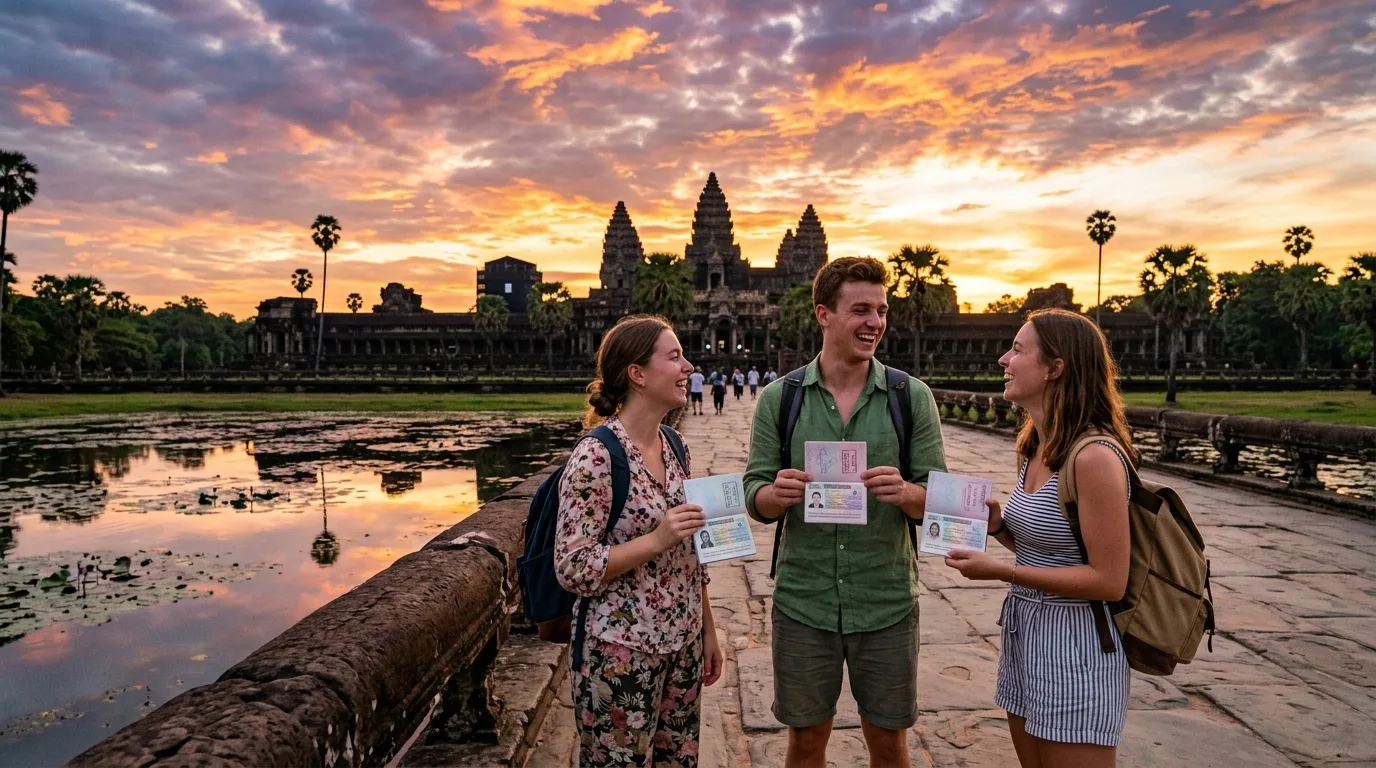

Navigating visa regulations can be one of the most stressful parts of traveling or living abroad. Fortunately, Cambodia remains one of the most expat-friendly countries in Southeast Asia when it comes to staying long-term. However, visa policies have become significantly more structured over the last few years.
Whether you are a digital nomad, a retiree, or a backpacker wishing to stretch your trip, this is your definitive, up-to-date guide to securing a Cambodia visa extension in 2026.
Understanding Your Base Visa (The Foundation)
Before you can extend a visa, you must understand what type of visa you hold. You cannot change your visa type inside the country; your extension must match the initial visa category you received upon entering Cambodia.
The two primary visa types that travelers and expats use are:
1. The Tourist Visa (T-Class)
- Who it’s for: Casual tourists and short-term backpackers.
- Initial duration: 30 days.
- Extension limit: Can be extended only once for an additional 30 days (giving you a total of 60 days). After this, you must leave the country.
2. The Ordinary Visa (E-Class)
- Who it’s for: Anyone planning to stay long-term (workers, retirees, students, digital nomads).
- Initial duration: 30 days.
- Extension limit: This is the visa that opens the door to long-term Extensions of Stay (EOS), ranging from 1 to 12 months.
Important Note: Do not confuse the E-class Ordinary Visa with the e-Visa (electronic tourist visa). If you enter Cambodia on an electronic tourist visa or a standard T-class tourist visa, you cannot extend your stay past 60 days without leaving and re-entering the country.
The E-Class Extension Types (EOS)
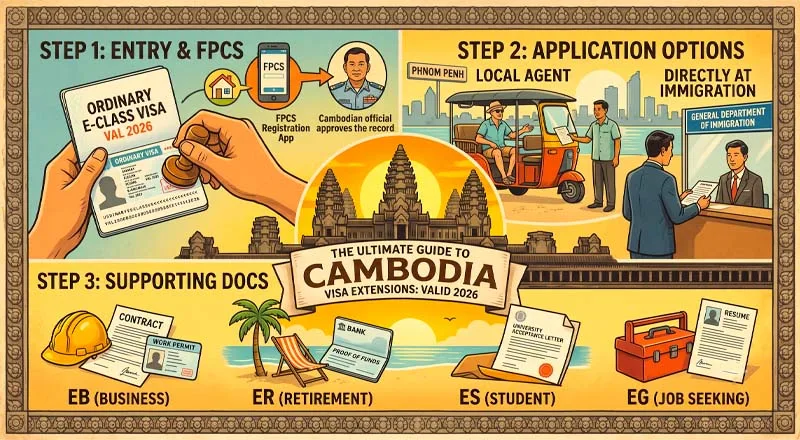
If you entered Cambodia on an Ordinary Visa (E-class), you can apply for one of four different Extensions of Stay (EOS) depending on your life situation:
1. EB Visa Extension (Business/Work)
This is the most common extension for employed expats, freelancers, and entrepreneurs. It can be issued for 1, 3, 6, or 12 months. To secure a 6 or 12-month EB extension in 2026, the Department of Immigration strictly requires a valid Cambodian Work Permit and an official employment letter from a registered company.
2. ER Visa Extension (Retirement)
Designed for foreigners aged 55 and older who are retired. You do not need a work permit for this extension, but you must provide proof of retirement or financial self-sufficiency (such as bank statements or a pension plan) showing you do not need to work locally.
3. EG Visa Extension (Job Seeking)
If you entered Cambodia on an E-class visa but haven’t secured a job yet, the EG extension allows you to stay for up to 3 months to look for employment. This extension is non-renewable; you must find a job and convert to an EB extension before it expires, or leave the country.
4. ES Visa Extension (Student)
For international students attending a registered Cambodian educational institution. You must provide an official admission letter from your school or university to qualify.
Essential Requirements for Extensions in 2026
To ensure your extension application goes smoothly, you will need to gather the following documents:
- Original Passport: Must have at least 6 months of validity remaining and at least two blank pages.
- Passport Photos: One or two recent passport-sized photos with a white background.
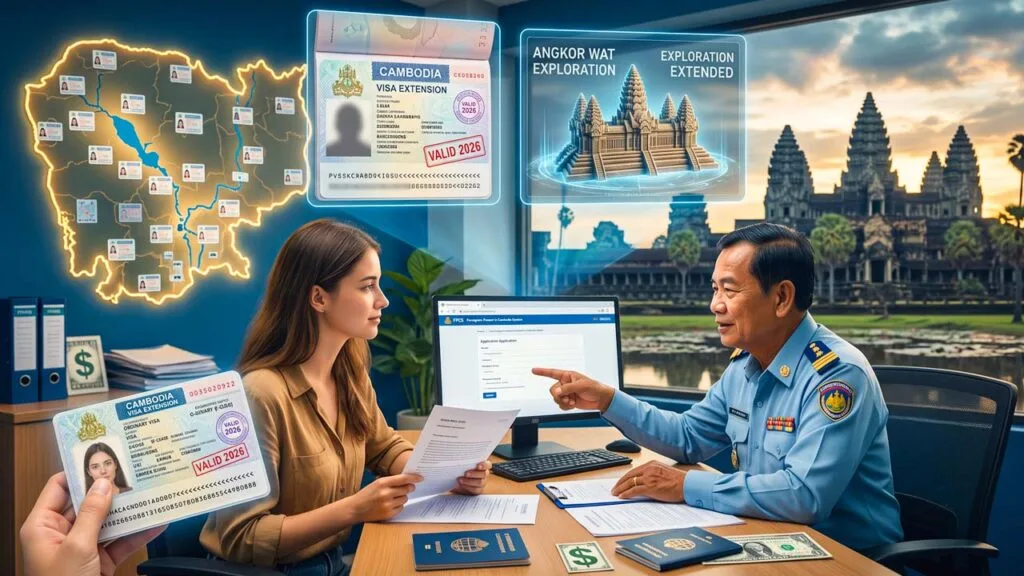
- FPCS Registration (Crucial): Cambodia utilizes the Foreigners Present in Cambodia System (FPCS) app to track where foreigners are staying. Landlords or hotels must register your presence in this app. The Immigration Department will digital-check this step; if you are not registered in the FPCS app at your current address, your visa extension will be rejected.
- Supporting Documentation: Work permits/employment letters (for EB), proof of funds (for ER), or school letters (for ES).
- Extension Fee: Paid in cash (US Dollars).
How to Apply: Two Main Pathways
There are two ways to process your visa extension in Cambodia.
Option A: Using a Registered Travel Agency (Recommended)
By far the easiest and most popular method for expats is using a local travel agent (widely available in Phnom Penh, Siem Reap, and Sihanoukville).
- How it works: You hand over your passport, photos, supporting documents, and cash to the agent. They handle the bureaucracy and return your passport with the new visa sticker inside.
- Processing time: Usually 7 to 10 business days.
- Cost: Standard agency fees usually add an extra $10 to $20 on top of the government visa price.
Option B: Applying Directly at the Immigration Department
If you prefer to save money or handle things yourself, you can visit the General Department of Immigration office directly, located opposite the Phnom Penh International Airport.
- How it works: You must dress formally, submit your paperwork in person, and fill out the official application forms.
- Processing time: 5 to 7 business days.
- Cost: You pay only the official government fee, but navigating the language barrier and administrative lines can be challenging.
Government Fee Breakdown (Estimated)
While prices can fluctuate slightly depending on the agent you choose, standard government fees for extensions generally align with the following ranges:
Overstay Fines and Consequences
| Extension Duration | Tourist (T-Class) Fee | Ordinary (E-Class/EOS) Fee |
| 1 Month | $30 – $50 (Single Entry) | $40 – $50 (Single Entry) |
| 3 Months | Not Available | $70 – $80 (Single Entry) |
| 6 Months | Not Available | $150 – $160 (Multiple Entry) |
| 12 Months | Not Available | $280 – $300 (Multiple Entry) |
Allowing your Cambodian visa to expire without an extension carries severe penalties. In 2026, the official overstay fine is $10 per day, payable directly at the airport or immigration office upon exit.
If you overstay for more than a few weeks, you risk being detained, blacklisted from re-entering the Kingdom of Cambodia, or formally deported at your own expense. Always check your visa expiration date and begin the renewal process at least 10 to 14 days before it expires.
Final Checklist for a Hassle-Free Extension
To wrap up your planning, run through this simple checklist to ensure a perfect renewal process:
- Double-check that your initial entry visa matches your long-term goals (Tourist vs. Ordinary).
- Confirm with your landlord or hotel management that your name is actively registered in the FPCS app.
- Keep your US Dollar bills crisp, clean, and un-torn if paying in cash.
- Drop off your passport with a trusted agent at least two weeks before your current visa expires.
By staying organized and keeping your paperwork updated, extending your stay in the beautiful Kingdom of Wonder is a straightforward process that will let you focus on enjoying everything the country has to offer.
Frequently Asked Questions
1. Can I extend a standard Tourist Visa (T-class) more than once?
Answer: No. A standard Tourist Visa (T-class) can only be extended once for an additional 30 days, giving you a maximum stay of 60 days. If you wish to stay longer than 60 days, you must leave Cambodia and re-enter on a different visa category.
2. What is the FPCS app, and why is it required for my extension?
Answer: The FPCS (Foreigners Present in Cambodia System) is an official app used by the government to track where foreigners are staying. Your landlord, host, or hotel must register your passport and current address in this system. Immigration officials will check this database digitally during your application, and if your registration is missing or outdated, your extension will be rejected.
3. Do I need a work permit to extend an Ordinary Visa (E-class) for a full year?
Answer: Yes, if you are applying for the EB (Business/Work) extension. To secure a 6 or 12-month EB extension, you are strictly required to provide a valid Cambodian Work Permit along with an official employment letter from a registered company.
4. What happens if I accidentally overstay my visa in Cambodia?
Answer: Overstaying carries immediate penalties. The official fine is $10 per day, which you must pay in cash at the immigration office or airport upon departure. Overstaying for extended periods can lead to more serious consequences, including detention, deportation, and being blacklisted from returning to the country.
5. Is it better to extend my visa through a travel agency or directly at the immigration office?
Answer: It depends on your preference. Using a registered travel agency is highly popular because they handle the bureaucracy for a small fee ($10–$20 extra), saving you a trip to the office. Applying directly at the General Department of Immigration (opposite the Phnom Penh International Airport) saves you the agency fee, but you will need to navigate the paperwork and administrative lines yourself.