

In the modern financial landscape, few assets command the enduring respect and fascination of gold. For millennia, it has served as a store of value, a medium of exchange, and a safe haven during turbulent times. In 2026, the gold market is more dynamic and complex than ever, driven by a convergence of global economic forces, geopolitical shifts, and the rapid pace of digital trading.
To navigate this volatility and make informed decisions, investors must harness the power of real-time data. A Live Gold Price Chart is no longer just a tool for professional traders; it is an essential resource for anyone looking to protect their wealth, diversify their portfolio, or capitalize on short-term market movements.
This article is designed to be the definitive guide to understanding, interpreting, and utilizing a Live Gold Price Chart. We will explore the fundamental and technical drivers of the gold price in 2026, break down the anatomy of a chart, and provide you with actionable strategies to integrate real-time data into your investment process.
The Anatomy of a Live Gold Price Chart
Before you can effectively use a live chart, you must understand what it is telling you. A Live Gold Price Chart is a graphical representation of the supply and demand for gold over a specific timeframe, updated multiple times per second.
1. The Core Data Point: XAU/USD
The foundation of the chart is the XAU/USD ticker.
- XAU is the ISO 4217 currency code for gold (based on the chemical symbol Aurum).
- USD represents the standard measurement currency: the US Dollar.
- The chart visualizes the spot price—the current market price for one troy ounce of 99.99% pure gold bullion, ready for immediate delivery.
2. Essential Chart Components
While charts can be customized with dozens of indicators, a standard professional setup in 2026 includes several key components:
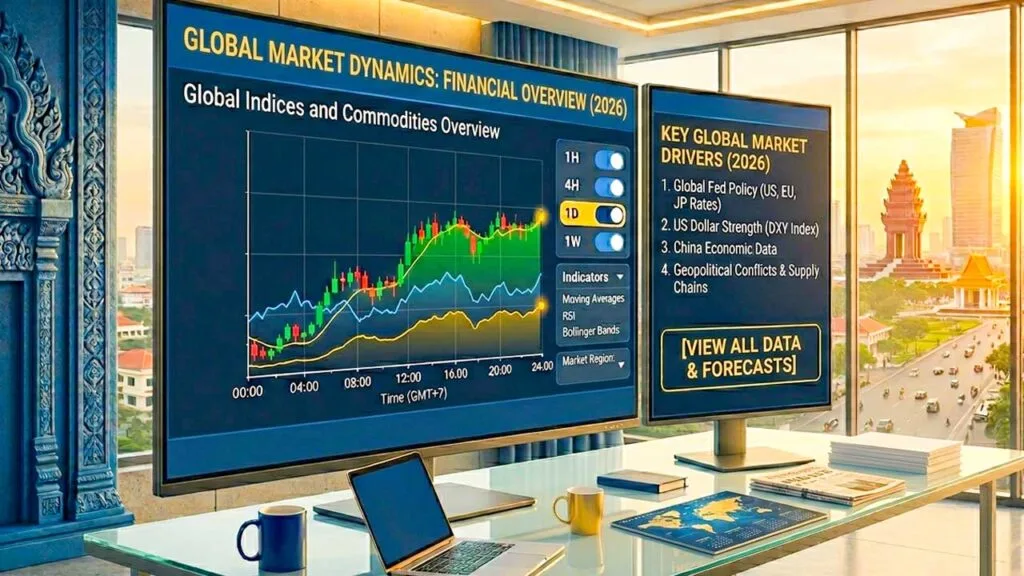
- A. The Price Axis: The vertical (Y) axis, showing the price per ounce in USD. In 2026, this axis often spans from $4,000 to over $5,000, reflecting the multi-year bull market.
- B. The Time Axis: The horizontal (X) axis, showing the timeframe selected.
- C. The Live Data Feed: A pulsating marker or “last price” line that indicates where gold is trading right now. A small “LIVE” indicator should be active when the market is open.
- D. Interactive Toggles: A robust chart must allow you to change the interval view. Common toggles include 1-Minute (1M), 1-Hour (1H), 4-Hour (4H), Daily (1D), and Weekly (1W). Different timeframes are crucial for different types of trading.
3. Understanding Volume
“Volume” is a critical metric often overlooked by beginner users. Located usually at the bottom of the chart as a bar graph, Volume shows the total number of ounces traded during the selected time interval. High volume accompanying a sharp price movement confirms the strength of the trend. Conversely, a price spike on low volume may indicate a lack of conviction and could be a “false breakout.”
What Drives the Live Price in 2026?
To interpret the chart’s movement, you must understand the underlying forces pulling the price up and down. While dozens of factors exist, four major “Market Drivers” dominate the live price action in 2026.
1. US Federal Reserve Monetary Policy (Interest Rates)
Historically, interest rates are gold’s most powerful antagonist. Gold is a “non-yielding” asset—it does not pay a dividend or interest. When the US Federal Reserve raises rates, other assets like bonds become more attractive because they offer a guaranteed yield. Conversely, when the Fed cuts rates, the opportunity cost of holding gold drops, and its price typically surges.
In 2026: Markets are acutely focused on the start of the next major rate-cutting cycle. Every time a Fed official makes a speech, or a key inflation report (like CPI or PCE) is released, the live chart reacts violently as traders try to guess if a cut is imminent.
2. Geopolitical Safe Haven Demand (The “Fear Trade”)
Gold is the ultimate “safe haven.” When global uncertainty, conflict, or terrorism rises, investors panic, sell risky assets like stocks, and buy gold.
In 2026: Continued, unresolved tensions in resource-rich regions (like the Middle East) or key global supply lines keep a permanent “fear premium” embedded in the gold price. A sudden escalation in conflict can cause the live chart to spike by $50 or even $100 in minutes, as global capital seeks safety.
3. Global Inflation & Currency Debasement
Gold is the premier hedge against inflation. When the global money supply expands rapidly (through “quantitative easing” or government spending) and fiat currencies weaken, the purchasing power of money drops. Gold, with its finite supply, retains its value.
In 2026: In the wake of massive monetary stimuli throughout the 2020s, global inflation fears remain elevated. If a major currency, like the Euro or Yen, shows signs of significant weakness, capital flows into gold, pushing the live USD spot price higher.
4. Central Bank Buying (The Structural Bull Case)
This is the hidden force that has created the 2026 bull market. Following the 2022 seizure of Russian foreign reserves, emerging economies (led by China, India, Poland, and Singapore) recognized that the US Dollar is not a truly neutral asset. To protect their national sovereignty, they are actively replacing USD and Euro reserves with physical gold.
In 2026: Central banks continue to buy gold at unprecedented rates. This buying creates a powerful “demand floor” for the market. Even if a strong US dollar puts pressure on gold, massive central bank purchases step in and absorb the selling, creating a very strong long-term support level on the daily and weekly charts.
Essential Strategies to Use a Live Chart for Investing
Knowing the drivers isn’t enough; you must apply this knowledge strategically. Here are four actionable strategies that professional investors use when interpreting a Live Gold Price Chart.
1. Mastering Support & Resistance Levels (Technical Trading)
Traders do not look at a chart for price points; they look for psychological boundaries.
- Support: A price level below the current price where gold historically struggles to fall further because buying pressure becomes very strong. Think of it as a “floor.”
- Resistance: A price level above the current price where gold historically struggles to break through because selling pressure becomes very strong. Think of it as a “ceiling.”
Application: When the live price approaches a strong support level (e.g., $4,700 in early 2026), technical buyers step in, anticipating a bounce. When it approaches a strong resistance level (e.g., $4,850), traders sell to lock in profits, anticipating a pullback. Breaking through these levels with high volume often triggers massive “momentum buying” or “selling.”
2. Trend Trading (Follow the Momentum)
This strategy is based on the idea that an asset is more likely to continue its current direction than to reverse.
- Uptrend (Bull Market): A series of higher highs and higher lows.
- Downtrend (Bear Market): A series of lower highs and lower lows.
Application: Investors use the daily (1D) and weekly (1W) charts to identify the main trend. In 2026, the trend is clearly up. An investor using this strategy will only enter “BUY” positions. They use a live chart to find minor “pullbacks” within the uptrend to buy, rather than trying to guess when the bull market will end.
3. Fundamental Event Timing (Trading the News)
Active traders time their entries based on major economic announcements. The gold market operates around a set calendar.
- Key Monthly Events:
- US Federal Reserve Rate Decision (FOMC Meeting): The #1 most volatile event.
- US Non-Farm Payrolls (NFP): Key labor data that influences the Fed.
- US CPI/PCE Inflation Reports.
Application: Traders will often clear their positions before a major event and watch the live chart as the data drops. If the data is “bullish for gold” (e.g., a higher-than-expected inflation print, signaling the Fed must keep rates high or start cutting), they buy immediately, riding the first explosive wave of momentum.
4. Dollar-Cost Averaging (The Gold Saver’s Plan)
This is the safest and most recommended strategy for long-term wealth preservation. It is not about timing the market; it is about time in the market.
Application: A disciplined investor using a Live Gold Price Chart will ignore the short-term volatility. They commit to buying a fixed value of gold (e.g., $100 or 1 Chi) every single month, regardless of the price. If the price is low on a live chart, their fixed budget buys more gold. If the price is high, it buys less. Over a period of months and years, this strategy creates a patient, growing portfolio that mitigates the risk of buying everything at a “top.”
Conclusion: Knowledge is Wealth Preservation
In the complex and often irrational financial world of 2026, gold remains the ultimate trusted asset. However, the price you pay matters. A Live Gold Price Chart is not a crystal ball, but it is a definitive tool that visualizes global investor sentiment.
By mastering the anatomy of the chart, understanding the four major global market drivers, and applying a disciplined investment strategy—whether you are a technical trader, a trend follower, or a patient Gold Saver—you transform from a passive observer into an informed, strategic investor.
At Sakmai Market Analytics, we believe that transparency is the key to financial empowerment. Make a live chart your trusted daily companion. Watch the levels, understand the news, and use real-time data to build and protect your wealth, now and for the future.
FAQ
1. What is the “Spot Gold” (XAU/USD) price, and why does it matter?
The “Spot Price” is the current international market price for one troy ounce of 24K gold, traded in US Dollars. It is the global standard used by banks and refineries. When you see XAU/USD rising on this page, it is almost certain that gold prices at your local shop in Phnom Penh will increase within hours.
2. Why has the global gold price broken records this March?
As of early March 2026, global prices have surged past $5,350/oz due to a “Triple Threat”:
- Geopolitics: Escalating military tensions in the Middle East have driven investors to gold as a “Safe Haven.”
- Central Bank Buying: Central banks in Asia and the Middle East are buying over 70 tonnes of gold per month to diversify away from the US Dollar.
- Inflation Fears: Rising energy and oil costs are making investors fear a new wave of global inflation.
3. Does a strong US Dollar always mean lower gold prices?
Traditionally, yes. Because gold is priced in Dollars, a strong USD usually makes gold more expensive for international buyers, leading to a price drop. However, in 2026, we are seeing a “Structural Shift” where both the Dollar and Gold are rising together because investors are worried about global stability and are buying both as safety assets.
4. What are the key technical levels to watch for XAU/USD?
Traders on our live chat are currently monitoring these critical levels:
- Resistance ($5,420): If gold breaks above this recent peak, analysts predict a “Moon Shot” toward $5,600.
- Support ($5,300): This is the current “Safety Net.” As long as the price stays above $5,300, the market remains in a strong Bullish trend.
5. How often is the global live chat updated?
Our global feed and live chat are active 24/7. While the local Cambodian markets close in the evening, the global market moves through the London and New York sessions overnight. Checking this page before you go to sleep can give you a “head start” on what the local price will be when shops open tomorrow morning.