
The gold market is currently navigating a period of intense volatility as competing macroeconomic forces tug at the spot price. While the long-term structural bull case remains firmly in place, the immediate trend has shifted toward a cautious consolidation phase.
1. Current Price Action & Technical Levels
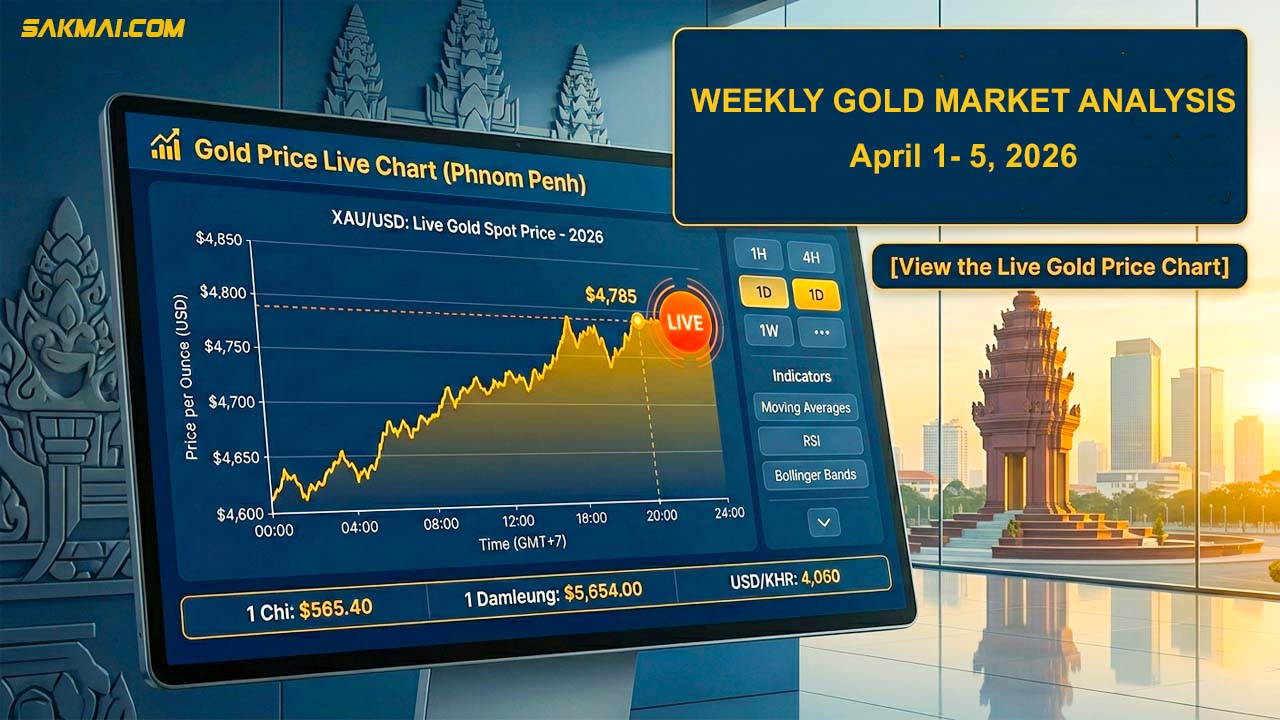
As of today, May 5, 2026, gold is trading near the $4,550–$4,600 region. This follows a sharp decline on Monday, May 4, where prices fell as investors reacted to a confluence of headwinds.
- Key Resistance: The 50-day moving average at $4,842 stands as the primary resistance hurdle. A reclaim of this level opens the path back toward the $5,131 zone.
- Key Support: The market is currently testing support near the $4,520–$4,550 level. If this fails, technical analysts are eyeing the 0.618 Fibonacci support near $4,376 as the next major floor.
- Short-term Momentum: The 1-hour chart reveals a descending parallel channel that has framed price action since late April. A confirmed breakout from the upper band targets $4,786, while a breakdown projects a bearish target at $4,326.
2. The Macro Headwinds: Three Converging Forces
The gold market in May 2026 is navigating a convergence of three mutually reinforcing headwinds that constrain its upside potential:
- US Dollar Strength: Sentiment is driven by expectations that the Federal Reserve will maintain restrictive monetary policy well into the second half of 2026.
- Rising Energy Costs: Brent crude is trading above $71.50 per barrel, reaching seven-month highs. Higher oil prices can sometimes pressure gold through their impact on the dollar.
- Elevated Treasury Yields: US 10-year yields have responded to inflation expectations being repriced higher in response to oil price dynamics.
3. Central Bank Demand: A Record-Breaking Foundation
Despite near-term price pressure, the physical foundation of the market remains historically strong.
- Structural Trend: The structural trend of higher central bank buying has further to run in 2026, according to J.P. Morgan Global Research.
- Buy-Side Conviction: Emerging market central banks—led by China, Poland, India, and Turkey—continue to systematically replace dollar-denominated reserves with gold.
- Quarterly Inflows: J.P. Morgan forecasts around 585 tonnes of quarterly investor and central bank demand on average throughout 2026.
4. Major Bank Forecasts: Year-End Outlook
Major financial institutions have maintained or raised their long-term price targets despite recent volatility.
- J.P. Morgan & Wells Fargo: These institutions have raised their year-end 2026 targets to a range between $6,100 and $6,300/oz.
- Goldman Sachs: Analysts maintain a target of $5,400/oz by the end of 2026, citing central bank diversification and expected easing by the Federal Reserve later in the year.
- UBS: Their year-end target stands at $6,200/oz, with an upside scenario of $7,200 if geopolitical risks escalate significantly.
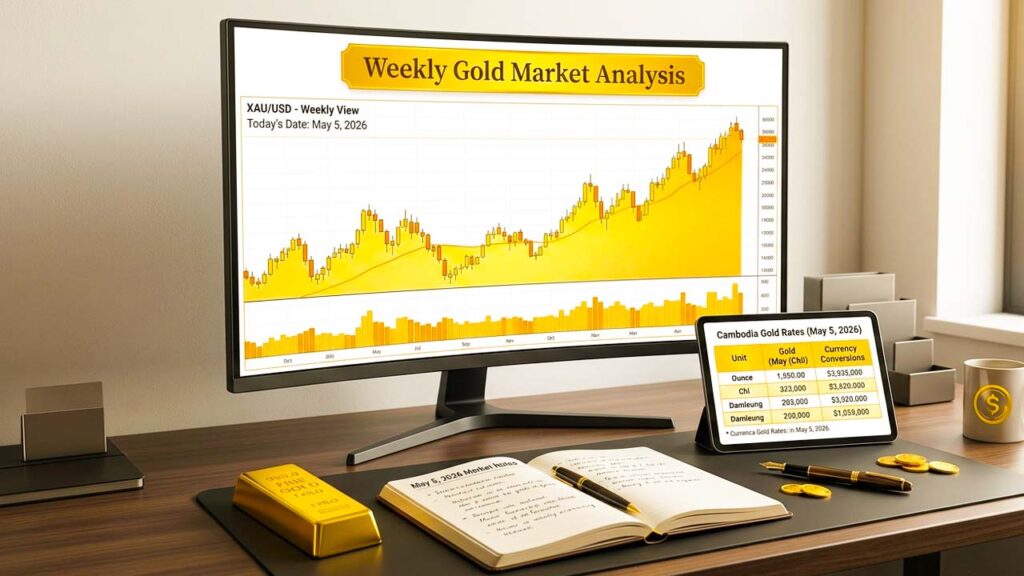
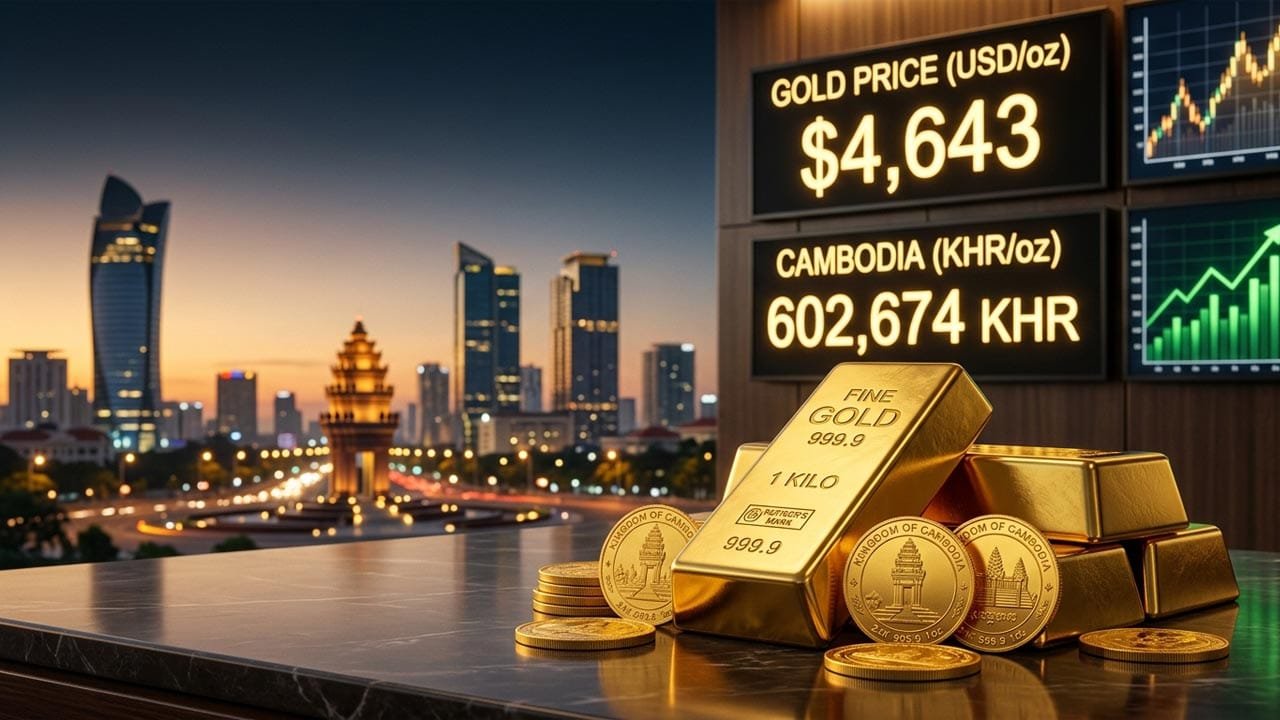
Gold Price Table in Cambodia (May 5, 2026)
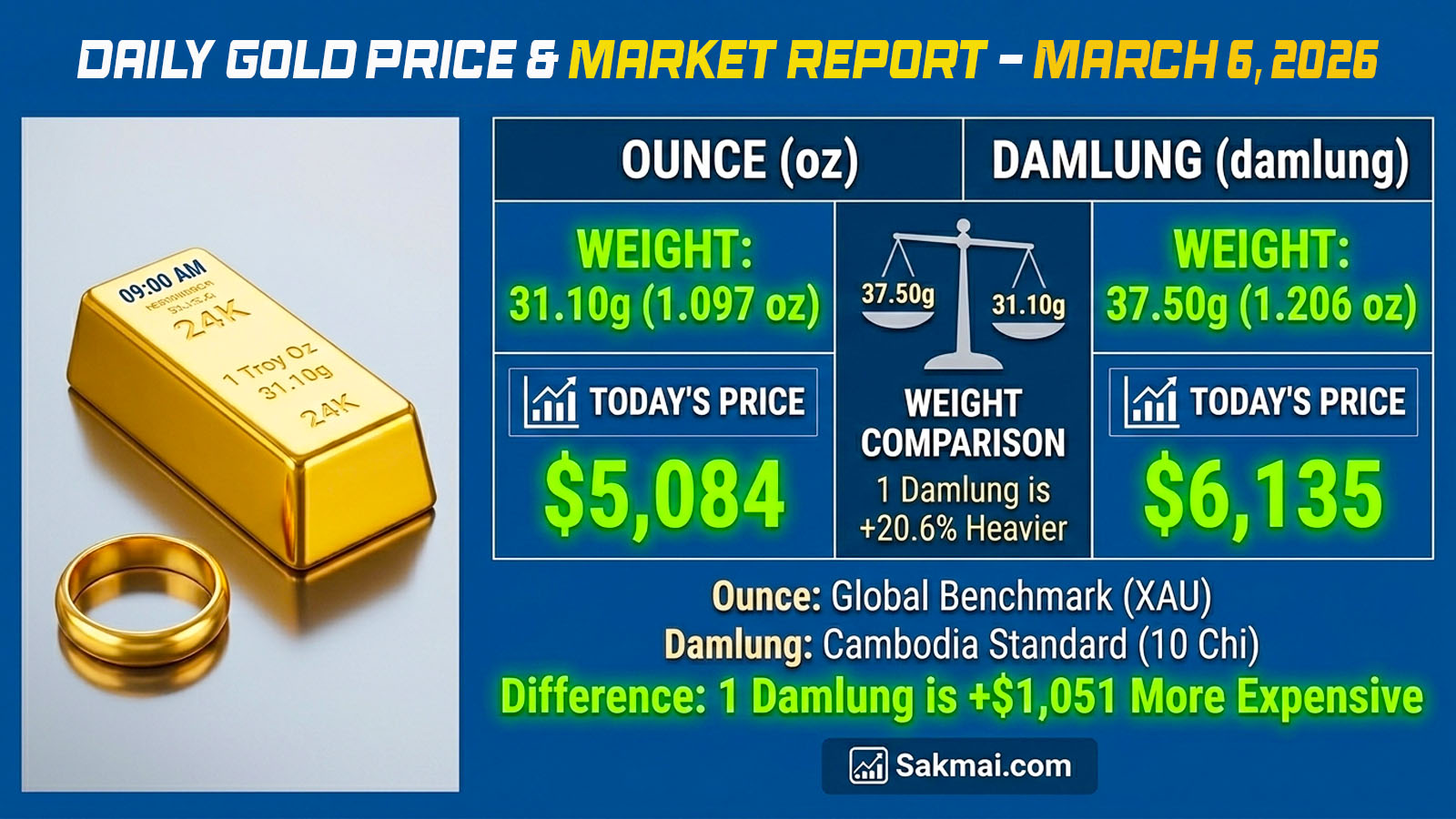
| Unit | Price (KHR) | Price (USD)* |
| Ounce | ៛18,297,356.37 | $4,559.73 |
| Damleung | ៛22,062,728.63 | $5,498.08 |
| Chi | ៛2,206,272.86 | $549.81 |
Verdict
The near-term bias for gold remains cautious as the market navigates “extreme pessimism” among some market-timers. Contrarian indicators suggest that gold and gold-mining stocks may be positioned for a gain over the next several weeks once this pessimism reaches a peak.
The Strategy: Watch for a successful defense of the $4,500–$4,550 support zone. While the path is not linear, the trends driving a “rebasing higher” in gold prices—including official reserve and investor diversification—are not yet exhausted. Investors are eyeing the $4,300–$4,400 area as a technically and fundamentally significant support zone several institutions have flagged for potential entry.
Frequently Asked Questions
1. Is gold still a good investment in May 2026 given current prices?
Yes, many major financial institutions maintain a bullish outlook for the remainder of 2026. While short-term volatility exists due to US Dollar strength and rising Treasury yields, analysts from J.P. Morgan and Goldman Sachs forecast prices could average between $5,055 and $5,400/oz by year-end. Gold continues to serve as a critical hedge against global inflation and geopolitical uncertainty.
2. Who are the primary buyers driving gold prices higher this year?
The 2026 market is primarily underpinned by massive central bank demand, which is projected to average around 585 tonnes per quarter. Leading buyers include emerging market central banks in China, India, and Turkey, who are diversifying their reserves away from the US Dollar. Additionally, institutional and retail demand for gold ETFs, bars, and coins remains at historically elevated levels.
3. What is the difference between living in BKK1 and Toul Tom Poung (TPP)?
BKK1 is known as Phnom Penh’s “foreign capital,” offering a high-end, international lifestyle with luxury high-rises, fine dining, and diplomatic residences. Toul Tom Poung (TPP), or the Russian Market area, offers a more balanced, “neighborhood” feel with boutique cafes and artisan shops at a slightly more affordable price point. BKK1 is ideal for those seeking maximum convenience and prestige, while TPP is popular with long-term expats and digital nomads.
4. What should I expect to pay for a serviced apartment in Phnom Penh in 2026?
Rental rates vary by district and building tier:
- Mid-range (e.g., Queston Residence): Approximately $500 – $900/month for 1 to 2-bedroom units.
- Luxury (BKK1 Premier units): Often start from $1,000/month and can exceed $2,800/month for premium multi-bedroom residences.
- TPP/Russian Market: Modern 1-bedroom apartments typically range from $400 to $800/month depending on facilities.
5. Are utilities typically included in Phnom Penh apartment rentals?
In most 2026 serviced apartment contracts, Wi-Fi, water, and cleaning services (1–3 times per week) are included in the monthly rent. However, electricity is almost always charged separately based on consumption, typically at the state rate of approximately $0.25/kWh. Some buildings may also charge separately for car parking.

![[LIVE] Cambodia Daily Gold Price & Market Report – March 1, 2026 _1](https://sakmai.com/wp-content/uploads/2026/03/LIVE-Cambodia-Daily-Gold-Price-Market-Report-–-March-1-2026-_1-1.jpg)
![[LIVE] Cambodia Daily Gold Price & Market Report – March 1, 2026 _1](https://sakmai.com/wp-content/uploads/2026/03/LIVE-Cambodia-Daily-Gold-Price-Market-Report-–-March-1-2026-_1.jpg)